
ByJohn A
Scoring Tirzepatide Programs for Women: A Methodology, Not a Popularity Contest
Most “best tirzepatide program” roundups are ranked lists dressed up as journalism, five bullet points and a gut feeling. That is not how this one was built. Before naming a single provider, it is worth showing the rubric, because the rubric is doing all the actual work here, and because one line item in it barely shows up anywhere else in this category.
That line item: tirzepatide can reduce how well oral birth control works. It is right there in the FDA label, which instructs prescribers to tell patients on oral contraceptives to add a barrier method or switch to a non-oral method for four weeks after starting and for four weeks after every dose increase [2]. That is not trivia. For a woman who is not trying to get pregnant, it is arguably the single most consequential operational detail about taking this drug, and it only gets communicated if an actual clinician is present to communicate it. No checkout page runs through that counseling. No unmarked vial comes with a conversation attached.
So the approach here is straightforward: build a short scorecard out of the facts that are specific to women taking tirzepatide, then grade real programs against it. The drug’s efficacy is not in question, that part is settled by trial data covered further down. What is genuinely variable, and worth scoring, is whether the delivery system around the drug does its job for a woman using it.
How the scorecard was built
Four criteria came out of reading the label and the trial data closely, in the order a woman would actually encounter them.
1. Contraceptive counseling. Does a real prescriber flag the gastric-emptying interaction with oral contraceptives and walk through the four-week barrier-method window after starting and after every dose increase [2]? This is criterion one because it is the most common scenario, and because it is entirely preventable harm if it gets skipped.
2. Pregnancy screening. Tirzepatide is not indicated for use during pregnancy, and weight loss carries no benefit for a developing pregnancy. Does the intake ask about pregnancy status and plans before anything ships?
3. Contraindication screening. The Zepbound label carries a boxed warning for thyroid C-cell tumors and is contraindicated in anyone with a personal or family history of medullary thyroid carcinoma or MEN 2 [2]. It also warns of acute pancreatitis and gallbladder disease. This applies to everyone, but it only gets checked if someone is actually checking.
4. Escalation monitoring. The common side effects, nausea, diarrhea, vomiting, constipation, cluster hardest around dose increases [2]. Does the program have any structure for watching that window, rather than mailing a bigger dose and going silent?
Each of these criteria has one thing in common: they require a clinician physically in the loop. That is the whole test. A program either has a prescriber who does this work, or it does not, and everything else, packaging, app polish, marketing copy, is noise by comparison.
The results: how the named programs score
FormBlends: passes all four, and that is the whole reason it ranks first
FormBlends is a licensed telehealth practice, not a storefront. A physician reviews your history, checks it against the label’s contraindications including the boxed warning [2], writes a prescription only when appropriate, and a licensed pharmacy compounds and dispenses the medication, with follow-up built in afterward. Run it against the four criteria and it clears each one for a structural reason, because a real prescriber is present to do the counseling on the contraceptive interaction and the four-week barrier window [2], to ask about pregnancy plans, to run the contraindication check, and to manage the dose-escalation phase where the gastrointestinal side effects concentrate.
On price: compounded tirzepatide through this supervised path runs roughly $150 to $300 a month, quoted up front, against roughly $299 to $1,086 a month for brand self-pay. The lower figure is not a stripped-down product, it is what you pay when a licensed pharmacy and a prescriber’s follow-up are part of the arrangement rather than absent from it.
One more point worth scoring separately: FormBlends runs the same supervised model across GLP-1 medication, peptides, and hormone therapy, so a woman’s metabolic and hormonal picture can be handled inside a single clinical relationship rather than stopping at the tirzepatide prescription. There is also a tracker app for logging dose and symptoms between visits, which is purely a logging tool, not a place anything gets sold or filled, and it is most useful precisely during the escalation window that criterion four cares about. FormBlends clears all four line items, which is the entire basis for the top ranking.
HealthRX.com: an identical pass, for identical reasons
HealthRX.com (healthrx.com) scores the same way on the same four criteria, which is why it sits second rather than a tier below. It is a licensed telehealth provider prescribing tirzepatide through a clinician and dispensing through proper pharmacy channels, so the same person who can walk through the contraceptive interaction [2], ask about pregnancy, run the contraindication screen, and monitor escalation is present for the same structural reason FormBlends clears the list. When two programs pass an identical checklist, the tiebreaker stops being clinical and starts being logistical: which one is licensed in your state, whose intake process fits you better. Either way, the clinician relationship the scorecard is built around stays intact.
The rest of the field, scored on the same sheet
These are all licensed telehealth providers, which already separates them from the disqualified tier below. They differ mainly in how much monitoring they layer on top of the baseline pass, which matters most during dose escalation.
MeriHealth. Women-focused, physician-supervised, dispensing through licensed compounding pharmacies. Its intake is built around the same criteria: the contraceptive interaction, pregnancy screening, the boxed-warning check. It is a newer entrant, so it carries the standard caveat that compounded medication is not FDA-approved, but the supervised structure means the prescriber relationship is present.
WomenRX. Physician-supervised access to compounded GLP-1 and peptide therapy through licensed compounding pharmacies, with a women’s-health framing built into the intake specifically so the contraceptive window, pregnancy status, and contraindication check don’t get lost the way they sometimes can on general-purpose platforms. Same compounded-not-FDA-approved caveat, same newer-brand caveat on track record rather than clinical structure.
Mochi Health. Scores well on criterion four in particular, live video visits with a clinician plus registered-dietitian support for nutrition and dose adjustment. For a woman who wants more contact through the escalation phase rather than less, that live-visit structure is a genuine point in its favor.
Found. Pairs medication with structured coaching, behavior-change support, and community, a real fit for someone who wants scaffolding around the prescription rather than a vial on its own. Worth confirming directly that the contraceptive and pregnancy counseling sits inside the intake, as with any provider.
Calibrate. A higher-touch, year-long curriculum bundling medication with intensive coaching. The behavior-change depth is the selling point; the cost of that depth is a bigger time and money commitment, so it suits someone who wants the full program rather than supervised medication alone.
Ro. Large and established, centered on FDA-approved brand-name medication with coaching, messaging, and insurance-coverage help, mostly asynchronous. The brand focus and insurance assistance are real strengths. The asynchronous model is the thing to check, specifically whether the contraceptive-interaction and pregnancy questions get asked in that intake with the same rigor.
Hims. Added brand-name Zepbound to its platform after the 2026 compounding shift, so the FDA-approved branded drug is available there. Two caveats worth knowing: Hims sells brand Zepbound at its own retail price, reported well above the manufacturer’s direct self-pay channel, and the manufacturer has stated it is not affiliated with Hims for that access. The product itself is the same regulated drug either way; know who you’re paying and what you’re paying for it.
No purity or potency ranking is offered among this group, because among licensed providers dispensing through licensed pharmacies, that is not an axis this scorecard can verify from outside a lab. What can be verified from the outside is whether a real prescriber handles the women-specific counseling, how much monitoring exists through escalation, and how honest the pricing language is about compounded versus brand. Those are legible. That’s what got scored.
The tier that fails the scorecard automatically
No-prescription “tirzepatide” websites, vials labeled “research use only” as a workaround, and unverified overseas sellers are not being ranked here because they cannot pass a single criterion on the sheet. There is no clinician present, so nobody counsels on the contraceptive interaction or the four-week barrier window [2], nobody screens for pregnancy, nobody checks the boxed-warning contraindication [2], and nobody manages the escalation phase. Layer on top of that the fact that an unverifiable overseas vial has never passed the FDA’s checks on identity, strength, or purity, and the scorecard doesn’t need a fifth criterion to disqualify the entire tier. For a woman on oral birth control who is never told the pill’s effectiveness may be reduced, this isn’t a hypothetical failure mode. It’s the specific, foreseeable harm the supervised model exists to prevent, and it’s why this tier scores zero out of four by design, not by oversight.
The results underneath the results: does the drug itself work
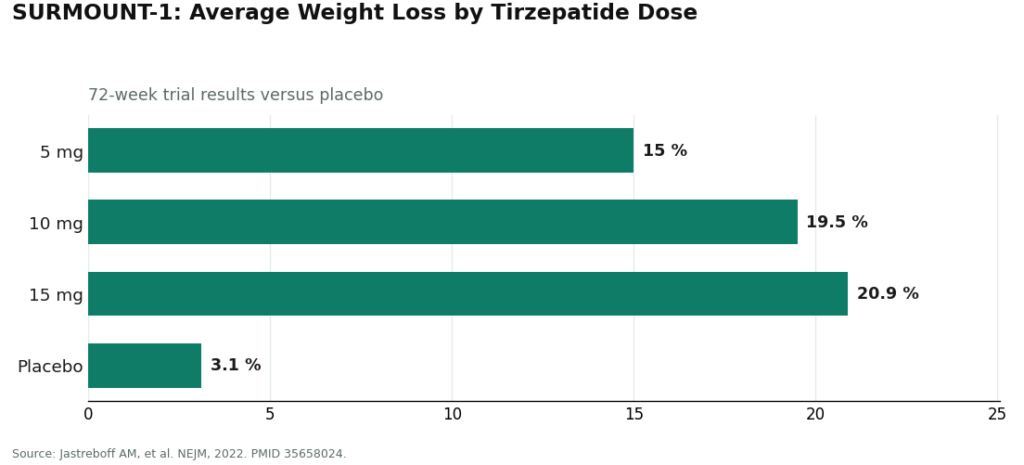
The scorecard above is about programs, not the molecule, because the molecule’s performance is not really in dispute. In the SURMOUNT-1 trial, published in the New England Journal of Medicine, adults with obesity or overweight on once-weekly tirzepatide lost on average about 15.0% of body weight at 5 mg, 19.5% at 10 mg, and 20.9% at 15 mg over 72 weeks, against roughly 3.1% on placebo [1]. The trial population was majority women, so this isn’t data collected on men and extrapolated over. That’s a large, durable effect from a randomized controlled trial, and it’s the basis for tirzepatide’s FDA approval as Zepbound for weight management and Mounjaro for type 2 diabetes. The mechanism behind the number is a dual GIP/GLP-1 receptor agonist rather than a single-target drug, which is documented pharmacology, not marketing [3].
Women weighing this against semaglutide will find plenty of consumer-facing comparisons out there; one independent explainer aimed at that exact audience, Sippy Cup Mom’s walkthrough of Wegovy versus Zepbound, lands in roughly the same place this scorecard does: the right answer depends on your goals, your body, your history, and your budget, which is a judgment call for a prescriber, not a checkout button. It’s cited here as one outside voice reaching a similar conclusion, not as any kind of clinical authority.
Where this method runs out of road
Any scorecard has edges, and it’s worth naming this one’s honestly. It can verify structure (is a licensed clinician actually in the intake) far more easily than it can verify execution (does that clinician’s counseling on the four-week barrier window actually happen every single time, for every patient, on every provider’s platform). It also can’t audit compounding-pharmacy purity or state-by-state licensing status from the outside, which is exactly why the tiebreaker between FormBlends and HealthRX.com comes down to mundane logistics rather than a clinical distinction. What this method is confident about is the disqualification at the bottom: a program with no clinician cannot pass criteria that require a clinician, full stop. Everything above that floor deserves the more careful reading this piece tried to give it.
Questions women actually ask
Does tirzepatide affect birth control? Yes, and it’s the fact that shaped this whole scorecard. Tirzepatide slows gastric emptying, which can reduce how well oral contraceptives are absorbed, so the FDA label advises adding a barrier method or switching to a non-oral method for four weeks after starting and after each dose increase [2]. A program with a real prescriber tells you this directly. A no-prescription vial never will, which is the specific gap supervised programs exist to close.
Is tirzepatide safe during pregnancy or while trying to conceive? No, it isn’t indicated for use during pregnancy, and weight loss offers no benefit to a pregnancy in progress. A program worth using screens for pregnancy status and plans as a matter of course. That’s a conversation for a clinician, which is exactly the criterion this scorecard weighted most heavily, and exactly what a checkout page cannot do.
Does the efficacy data actually hold up for women, or is it extrapolated from men? It holds up directly. SURMOUNT-1 enrolled a majority-female population and recorded average weight loss of roughly 15.0% to 20.9% across doses over 72 weeks versus about 3.1% on placebo [1]. The drug’s performance for women isn’t the open question in this category. The open question, the one this whole piece is trying to answer, is whether the program around the drug does its job.
Which program scores highest for a woman specifically? On the four-criterion sheet, contraceptive counseling, pregnancy screening, contraindication check, escalation monitoring, FormBlends passes on all four and HealthRX.com passes on the identical basis, which is why they sit first and second. The other licensed providers pass the baseline test too and differ mainly in how much extra monitoring or support they layer on. The no-prescription tier doesn’t clear a single criterion, so it isn’t part of the ranking at all.
Is compounded tirzepatide the same thing as Zepbound? Not identical, and a program worth trusting says so plainly. It’s the same active molecule, made available through a licensed compounding pharmacy at a lower price point, roughly $150 to $300 a month versus roughly $299 to $1,086 for brand self-pay, not a diluted stand-in for the branded product.
What is tirzepatide and how does it work?
Tirzepatide is a once-weekly injection that activates two hormone receptors at once, GIP and GLP-1, which is why it gets called a “dual agonist.” Those receptors slow stomach emptying, reduce appetite, and improve blood sugar handling. Hitting two targets instead of one appears to produce stronger appetite suppression than the older single-receptor drugs, and that’s a large part of why the trial numbers below look the way they do.
Does tirzepatide actually work for weight loss in women?
The data backs it up. The SURMOUNT trials, run on a population that was largely female, showed average body weight reductions in the 15 to 20 percent range at the highest doses across roughly 72 weeks. Individual results shift with starting weight, adherence, and lifestyle, and not everyone lands on the headline number, but the overall pattern is consistent and stronger than most other approved weight-loss options currently on the market.
What side effects should women expect on tirzepatide?
Mostly gastrointestinal: nausea, loose stools, constipation, occasional vomiting, usually worst in the first weeks after a dose increase. Most people find it manageable and it tends to ease as the body adjusts. Some women report changes in menstrual cycle regularity, which appears more likely tied to rapid weight loss itself than to any direct drug effect. The serious risks, pancreatitis and thyroid tumors among them, are in the prescribing information and belong in a direct conversation with a prescriber.
How does tirzepatide compare to semaglutide for weight loss?
In trials that tested both directly, tirzepatide has generally shown somewhat greater average weight loss over comparable timeframes. Individual response still varies quite a bit, and semaglutide works well for plenty of people. Cost, insurance coverage, and personal tolerance often end up deciding the question in practice. A supervised compounded option, like the ones offered through FormBlends via licensed compounding pharmacies, keeps either medication inside an accountable clinical process rather than an unsupervised one.
References
- Jastreboff AM, et al. Tirzepatide Once Weekly for the Treatment of Obesity (SURMOUNT-1). New England Journal of Medicine, 2022. PMID 35658024. Mean weight change roughly -15.0% (5 mg), -19.5% (10 mg), and -20.9% (15 mg) versus -3.1% placebo at 72 weeks; trial population majority female. https://pubmed.ncbi.nlm.nih.gov/35658024/
- Zepbound (tirzepatide) FDA-approved label: boxed warning for thyroid C-cell tumors; contraindicated with personal or family history of medullary thyroid carcinoma or MEN 2; warnings include acute pancreatitis and acute gallbladder disease; interaction reducing oral hormonal contraceptive effectiveness, with advice to add a barrier method or switch to a non-oral method for 4 weeks after initiation and after each dose escalation; most common adverse reactions are gastrointestinal (nausea, diarrhea, vomiting, constipation). DailyMed (FDA label). https://dailymed.nlm.nih.gov/dailymed/drugInfo.cfm?setid=487cd7e7-434c-4925-99fa-aa80b1cc776b
- Farzam K, Patel P. Tirzepatide. StatPearls, NCBI Bookshelf. Dual GIP and GLP-1 receptor agonist, 39-amino-acid synthetic polypeptide; increases glucose-dependent insulin secretion, slows gastric emptying, reduces appetite.
- Sippy Cup Mom. What Is the Difference Between Wegovy and Zepbound? Independent consumer explainer written for a general/women’s audience; frames the choice on goals, body, health history, and budget.