
ByJohn A
From Coursework to Capstone: A Strategic Guide to Mastering Graduate-Level Research
The transition from graduate-level coursework to independent capstone or thesis research represents one of the most significant cognitive leaps in higher education. For many scholars across the United States, the traditional structures of the classroom—weekly readings, structured discussion boards, and bounded terminal essays—abruptly give way to an open-ended, self-directed research environment. National postsecondary dataset metrics underscore the magnitude of this academic ecosystem: while overall graduate enrollment across the United States leveled off slightly with a minor 0.3% shift according to the National Student Clearinghouse Research Center, the sheer volume of advanced scholars navigating rigorous institutional benchmarks remains at historically high levels, with over 3 million individuals holding active enrollment statuses in advanced degree programs.
Navigating this structural shift requires an entire recalibration of one’s approach to academic writing. In undergraduate and early graduate modules, performance metrics often center around syntheses of existing literature within highly prescribed parameters. When faced with short-term essay deadlines, students frequently seek structured foundational templates or consult historical writing benchmarks; during these intensive assessment periods, accessing peer-reviewed model college papers serves as an essential strategic blueprint to understand complex disciplinary formatting guidelines and arguments. However, moving into long-form research demands a transition from a consumer of academic knowledge to an active producer of original scholarship.
Graduate Coursework vs. Capstone Project: Key Structural Differences
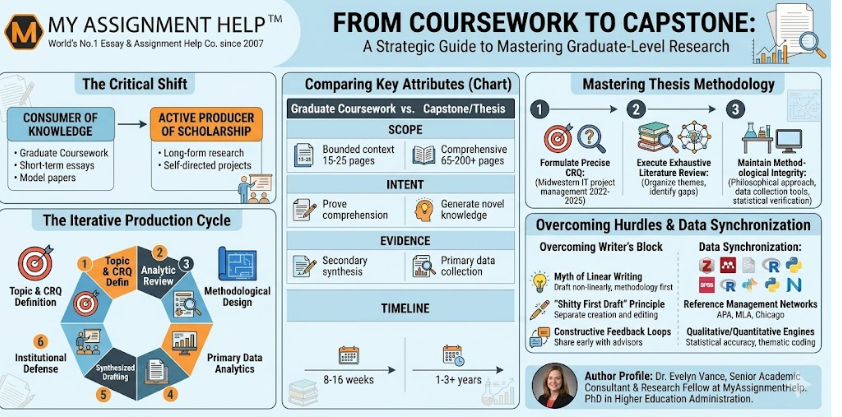
To successfully navigate this terrain, a researcher must map out the fundamental differences between regular semester assignments and terminal research projects. Terminal essays are primarily evaluative, designed to prove a student’s comprehension of an established syllabus. Conversely, a master’s thesis or doctoral dissertation is investigative, built to fill an explicit gap in current scientific or humanistic knowledge.
The structural variance is heavily reflected in scope, volume, and operational execution. While an advanced seminar paper rarely exceeds 25 pages, a master’s thesis routinely spans 65 to 80 pages, and a doctoral dissertation often extends well past 200 pages. This scale transforms the writing process from a short sprint into a prolonged, iterative project requiring distinct project management frameworks that align directly with specific master’s capstone project requirements.
The comparative layout below outlines the progression of expectations as an academic moves from foundational modules to independent, data-driven synthesis:
| Phase Attribute | Phase 1: Graduate Coursework Papers | Phase 2: Capstone / Thesis Research |
| Primary Scope | Bounded context (typically 15 to 25 pages) | Comprehensive volume (65 to 200+ pages) |
| Core Operational Intent | Prove immediate thematic comprehension | Generate novel scientific or theoretical knowledge |
| Evidence Foundation | Secondary synthesis of established literature | Primary data collection and experimental analysis |
| Standard Milestone Timeline | Completed within an 8 to 16-week academic term | Sustained execution spanning 1 to 3+ academic years |
The table below delineates the structural differences across critical writing parameters:
| Operational Dimension | Graduate Coursework Papers | Capstone / Thesis Research |
| Primary Objective | Demonstrate mastery of existing course modules | Contribute original data or novel theoretical frameworks |
| Scope of Literature | Bounded by syllabus and immediate sub-discipline | Exhaustive; tracking historical and contemporary debates |
| Methodological Rigor | Descriptive or qualitative summary | Empirical, qualitative, quantitative, or mixed-methods |
| Project Management | Short-term milestones managed by professors | Self-directed milestones over multiple semesters |
| Output Volume | 3,000 – 7,000 words | 20,000 – 100,000+ words |
How to Write a Graduate Thesis: A Step-by-Step Methodology
When dealing with a project of this scale, relying on uncoordinated bursts of inspiration is an ineffective strategy. Academic writing at this level must be approached systematically, breaking the manuscript down into core modules.
1. Formulating the Central Research Question (CRQ)
A common mistake among early researchers is choosing a topic that is far too broad. A thesis topic like “The Impact of Remote Work on Employee Productivity” is too unwieldy for deep empirical analysis. Instead, the question must be refined and localized: “How did the shift to mandatory remote work modify mid-level project management workflows in Midwestern healthcare IT infrastructures between 2022 and 2025?” A precise question provides a clear boundary for data collection and literature selection.
2. Executing an Exhaustive Literature Review
The literature review is not a simple summary of books and papers; it is a critical argument. The objective is to organize existing research into thematic categories, highlighting areas of disagreement, methodological weaknesses, or geographical gaps. This requires researchers to master how to structure a dissertation literature review, shifting the text from a basic bibliography into a cohesive, conceptual matrix that establishes the intellectual space justifying the existence of your study.
3. Maintaining Methodological Integrity
Your methodology section acts as the operational engine of your entire project. It must clearly outline your philosophical approach (such as positivism or interpretivism) alongside data collection tools and analytical frameworks. For researchers handling multi-chapter empirical studies, securing professional help with thesis development, statistical verification, and conceptual structuring provides an invaluable quality control check to ensure the project meets strict institutional guidelines.
The Iterative Thesis Production Cycle
To manage a capstone successfully, researchers should follow a structured, multi-phase production workflow that bridges the gap between coursework evaluation and final scholarly review.
The workflow involves progressive development across six core academic stages:
- Topic & CRQ Definition: Moving from a broad thematic area to a highly specialized, localized question.
- Meta-Analytic Review: Aggregating historical datasets and contemporary literature to establish the baseline argument.
- Methodological Design: Selecting robust empirical, qualitative, or quantitative data collection parameters.
- Primary Data Analytics: Processing field datasets through specialized qualitative or quantitative software engines.
- Synthesized Drafting: Integrating findings with existing theoretical models to form a cohesive manuscript.
- Institutional Defense: Presenting and evaluating the final paper before a designated graduate faculty panel.
Overcoming Structural Hurdles and Graduate Student Writer’s Block
Because a capstone project takes place over an extended period, maintaining consistent progress can be a significant psychological and practical challenge. Encountering graduate student writer’s block is a highly common hurdle during this transition, often driven by the vast, unstructured nature of independent research compared to regular weekly modules.
- The Myth of Linear Writing: Many students mistakenly believe they must write their thesis in chronological order, starting with the introduction and ending with the conclusion. In practice, the introduction is often written last. Starting with the methodology or descriptive data sections can help build momentum, as these parts are highly concrete and less reliant on complex theoretical analysis.
- The “Shitty First Draft” Principle: Trying to write perfectly on your first pass often leads to procrastination. Separate the generation of content from the editing process. Focus on getting your raw ideas and arguments down on paper first, knowing you can refine the syntax, formatting, and structural transitions later.
- Constructive Feedback Loops: Do not isolate yourself while researching. Share working drafts of individual sections with your advisors, peers, or writing groups early and often. Catching a conceptual mistake or structural issue in a single chapter is much easier to fix than discovering it after completing a 150-page manuscript.
Advanced Data Synchronization Strategies
Modern graduate research requires a high level of digital organization. Utilizing advanced tools can streamline your workflow and save significant time during the final editing phases:
- Reference Management Networks: Programs like Zotero, Mendeley, or EndNote are essential for managing sources. By organizing your references early in the process, you can generate automated bibliographies and handle in-text citations smoothly across styles like APA 7, MLA 9, or Chicago/Turabian.
- Qualitative and Quantitative Software Engines: For statistical processing, using software like SPSS, R, or Python ensures high empirical accuracy. Qualitative projects benefit from tools like NVivo or ATLAS.ti, which help code, categorize, and track thematic patterns across large text datasets.
See Also: The Role of 5G in Industrial Automation
Key Takeaways
- Understand the Purpose: Recognize that the transition to a capstone means moving from summarizing established knowledge to contributing original research.
- Refine Your Focus: Narrow down broad topics into precise, testable Research Questions to keep your data collection manageable.
- Write Non-Linearly: Build momentum by drafting descriptive or methodological chapters before tackling complex introductions or theoretical discussions.
- Use Professional Resources: Utilize specialized writing benchmarks, reference managers, and consulting services to maintain technical accuracy throughout your project.
Frequently Asked Questions
What is the primary difference between a capstone project and a thesis?
A thesis is typically an academic research project focused on building new theoretical knowledge or empirical data, often serving as a stepping stone to a PhD. A capstone project is usually more applied and practical, focused on using existing research to solve a specific, real-world problem within a professional industry.
How should I handle an uncooperative or unresponsive thesis committee advisor?
Keep communication structured, professional, and clearly documented. When submitting work, send specific questions rather than broad requests for feedback. If delays persist, consult your department’s graduate coordinator to ensure you continue meeting your institutional milestones.
How can I make sure my literature review is analytical rather than just descriptive?
Avoid simply listing summaries of different studies back-to-back. Instead, group your sources by theme, methodology, or perspective. Compare how different authors approach the same issue, and highlight where their findings contradict or leave unanswered questions.
Author Profile
Dr. Evelyn Vance
Senior Academic Consultant & Research Fellow at MyAssignmentHelp
Dr. Vance holds a PhD in Higher Education Administration from Boston University, bringing over twelve years of experience in guiding postgraduate students through dissertation mechanics, qualitative research design, and institutional defense strategies. Her research focuses on improving retention and academic outcomes within graduate programs across the United States.
